
Saturday, April 19, 2014

Friday, April 18, 2014
Heresy, Humor, or Bad Taste? You Decide!
I’ve always liked the stories about Mary and Martha. They told us in Sunday School that Martha was
too involved with worldly things (like making sure a houseful of people got
something to eat) and Mary was more interested in listening to Jesus. Mary, we were told was right. After all, Jesus said she had chosen “the
Better Part.” (Luke 10:42)
Unfortunately, I never thought to use this as Biblical justification
for my preferring sitting around and talking to cooking and cleaning up, even
though the things I wanted to sit around and talk about (everybody’s love life,
workplace drama, what was going on with Friends,
The Sopranos, The Big Bang Theory) wouldn’t have qualified for “the Better
Part.”
The story of Mary and Martha has something for
everyone: sibling rivalry, the
philosophical tension between being and doing, maybe even some romance. I still wonder if there was some romantic tension
between Jesus and Martha. She complains
to him that he should tell Mary to help her.
("Lord, do you not care that my sister
has left me to serve alone? Tell her then to help me." Luke 10:40)
He then basically tells her to chill. Later
when Jesus is about resurrect Lazarus, Martha points out the he has been dead
for four days and smells. Jesus rebukes
her “"Did I not tell you that if you would
believe you would see the glory of God?"
(John 11:40) Maybe
Martha missed that when she was in the kitchen.
Does this remind you of Tracey and Hepburn or any Meg Ryan movie?
And maybe Mary was interested in Him, too. Isn’t there something kind of steamy about
her pouring perfume on Jesus’s feet and drying them with her hair? Let’s face it, in that story, Mary is no
longer a slacker but a hottie.
And I’ve wondered why Mary and Martha were single and living
with their brother. Were they waiting
for husbands? Instead of the young women
I’ve always pictured, maybe they were confirmed spinsters like those found in
English “cozy” mysteries or the novels of writers like Barbara Pym. I can picture a modern Martha in good tweeds
and sensible shoes running the church bazaar, while Mary had earnest
discussions with the unmarried vicar.
But we never find out what happened to them. Did they ever get married? Did they become leaders in the new church? I’m a romantic and a feminist. I hope they did both.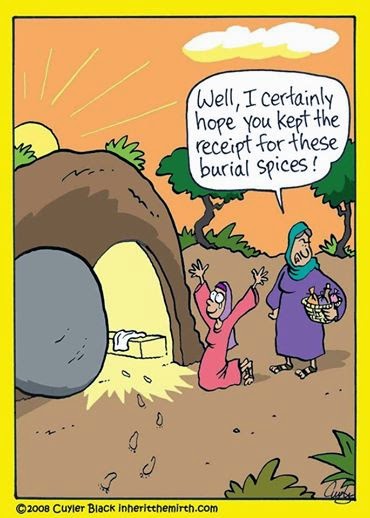
Monday, April 7, 2014
It's not string theory . . . or is it?
I don’t understand string theory, although I’ve tried. Well, I looked it up on Wikipedia. I got halfway through the first
sentence. Thanks to The Big Bang Theory, “string theory” has now replaced “rocket
science” as the ultimate impossible-to-fathom thing that something else (like
changing a tire or retrieving lost computer files) is not. (Or supposedly is not.)
Supposedly, Christianity is not string theory. Some say it can be reduced to “Love God. Love
your neighbor. Love yourself.” Others say, “The Old Testament has ten
commandments and the New Testament has two.
Everything else is a suggestion.”
That sounds simple enough.
But then we come to the double problem of Details and
Stuff. How long did it take God to
create the universe? Did Moses turn the Nile into blood or was it just red mud?
Was Mary really a virgin? The Old
Testament is full of details and a lot of them are about Stuff – how to build
the temple, how to sacrifice animals, what the priests should wear, what to eat
or not eat, how to treat skin disorders.
(Leviticus goes into great detail about the making of beautiful things
for the Tabernacle and then talks about smearing them with the blood of the
sacrificed animals.)
And today, we still have details: millions of books about theology, millions of
debates in meetings in churches, millions (Or is it billions?) of people
worrying if they are “doing Christianity” right. How many of them are making themselves sick
with this worrying?
And of course, there is Stuff: candles, altars, incense, stained glass. A lot of it is beautiful and even fun. But what is the Stuff doing to create
Christians? This creates the problem of
how we should feel about Stuff.
Have Details and Stuff turned Christianity into string
theory? Do they have to?
Not necessarily. And
maybe the problem is not that they are making Christianity harder, but that as
simple as it really is, the problem is that doing is a lot harder than
understanding.
I don’t have a solution.
But maybe the first step is to stop worrying about the Details and
Stuff. You won’t be able to ignore them;
you just don’t have to worry about them.
Loving God, our neighbors and ourselves is challenging enough.Saturday, April 5, 2014

Saturday, March 29, 2014
Scenes from an Urban Parish
Every morning the sexton picks up beer cans and liquor
bottles from the lawn. Sometimes there
are syringes and needles, too.
Homeless people sleep in the churchyard and cemetery at
night. They figure out what time the
police drive through so they can hide.When women go up to take Communion, they take their purses with them.
The church is kept locked when not in use.
When the secretary is alone in the office, she keeps the door locked.
A parishioner is mugged.
The perpetrator is caught, spends nine months in jail, then gets
probation and rehab. Several years
before, the parishioner’s teenage daughter was held up at gunpoint in the
convenience store where she worked. The
robber is caught, but in spite of identification by two witnesses, is acquitted.
A teenage parishioner is set upon by three
acquaintances. He has to have his jaw
wired and lives on milkshakes for weeks.
A large drug store, open twenty-four hours a day,
opens. The spot becomes a magnet for
prostitutes and their customers. The
drug store changes its hours to nine to nine.
The neighbors of noisy bar, the scene of many fights, try to
have the bar closed. After a shooting,
it is. A company buys the property to
use as a methadone clinic. The
neighborhood, after demonstrations and with the help of legislators, gets the
court to stop the purchase. The clinic
appeals and wins. The status is still
uncertain.
The Diocese asks that before every meeting, service, or event
the question “How does what we are doing impact those living in poverty?” be
asked.
During an evening committee meeting, a man comes to the
door. He says he and his family have
just come to the city and are homeless and asks for money to stay in a
motel. The committee members debate
whether they should call the rector for money from the Discretionary Fund or
chip in themselves. In the end, they do
nothing, but feel guilty. On Sunday at
Coffee Hour, another parishioner tells of being approached by someone who fits
the description of the man with the same story a week before in the parking lot
at the mall.
The Diocese suggests that for Lent everyone limit his or her
food expenses to thirty dollars per person per week, which is the average Food
Stamp allotment. The Bishop says he is
going to do it, but does not say how he is going to count the free food at meetings,
receptions, etc.
A parishioner who works in a supermarket sees Food Stamp
cards being sold for cash.
I’m just saying
Thursday, March 20, 2014
Unearned Atheism -- The Slacker in the Stroller
One of my favorite dead wrong but nice people is Hement
Mehta, The Friendly Atheist. Not only is
he unfailing polite as he points out the silliness of belief, but he does it
with charm and humor. His blog, The
Friendly Atheist and his You-Tube videos on Atheist Voice include such topics
as “Atheist at a
Megachurch”, “What Do Atheists Believe Happens to You When You Die?” and
“Fifteen Things You Should Never Say to an Atheist.” (I was impressed that he didn’t call it
“Fifteen Stupid Things You Should Never Say to an Atheist.”)
I was glad to see that believers aren’t the only ones who
should watch their mouths. Mr. Mehta has
a video “9 Things Atheists Should Stop Saying,” such as “I lost my faith,” or
“I can be good without god.” But the
no-no that I found the most interesting was, “Babies are born atheists.” This is not because he thinks babies believe,
but because they have not earned the right to be called atheists. All a baby has to do is exist. To be an atheist, he or she has to be
bombarded with information such as that there is nothing beyond the material world,
that Grandma would have survived the triple by-pass even if no one had prayed
for her, that his or her best friend's pastor, who is like a cool aunt or uncle or favorite grandparent, is either
stupid beyond belief or, worse, a fraud and hypocrite. And don’t forget the biggie – when you die,
bada bing, bada boom, that’s it for you.
Then the baby, who is by now at least in middle school has earned the
title of atheist and can wear atheist t-shirts and necklaces with charms that
say, “God free” as he or she rides around in the family car with the cute
animal on the back that says “Evolve.”
Well, I don’t think babies are born atheists; I think we are
all born with a capacity to believe.
Researchers have proposed the idea of a “God gene” that predisposes
people to spirituality. It even has a
name, VMAT2. But it is more than a God
gene. Throughout history people have
been creating rituals and beliefs for themselves, partly out of fear and a
desire for explanation of the world. But
I think it also came from wonder, the desire for something greater than
oneself, and the marvelous realization looking at the world, that there must
be. And perhaps the God gene is part of
God’s gift to us.
Belief has survived disasters, evil, and various Ages of
Doubt and Reason.
A baby does not have to earn the title of believer or
Christian. Nobody does. Belief is in us already. And Jesus can be, too, if we believe.


Saturday, March 8, 2014
Examine Your But
The Episcopal Church has a full spectrum of religious views.
In my parish there are those who think Pope Francis is too
liberal. And then there people like me,
Whateverists, some of whom, like me, have decided opinions about where the
altar should be. And most people are in
the middle. But we manage to get along,
generally.
Sometimes it seems that the biggest debate at coffee hour is
whether Hitler had a shot at getting into heaven.
Then there’s the legend of the Bishop who said maybe the
Resurrection didn’t happen like it said in the Bible, but also talked about how
God spoke to him. Frankly, I have
trouble with both of these statements, but I tell myself that he is entitled to
his truths. Maybe we can talk about in
heaven.
This diversity is great, but sometimes we (or at least I)
may get confused about how strong our belief are or even what they are.
So Episcopalians, or anyone who would like to clarify his or
her views, may be interested in the psychological test or parlor game “I’m
__________, but . . .” First you have to complete the first clause. “I’m a liberal, but” “I’m no liberal, but” “I’m conservative, but” “I’m old school, but”. Or “I don’t believe in labels, but. . .” This may be the easy part. Most people have a sneaking attachment to
their labels. It gives us a sense of
identity and solidarity. And the anti-label
people are even more attached to anti-labelism.
The interesting part comes after the “but.” “I’m not High Church, but some smells
and bells in the service might fun.”
“I’m no liberal, but why can’t everyone have health insurance?” “I’m pretty conservative, but the world was
created in six twenty-four hour days?
Seriously?”
“I’m sure (Sarah Palin, Bill O’Reilly, the Pope, Hilary
Clinton, Jon Stewart, Bill Maher or whoever) isn’t a bad person, but in some
things he or she says are just dead wrong.”
What does your “but” tell you about yourself? What kind of new ideas (new to you, at least)
does it stir up? At the very least it
will demonstrate that people, even you, can have seemingly conflicting
opinions. If you think everyone should
have health insurance, how should they get it?
What good ideas does the Pope or Jon Stewart have? You might even want to write about it. (Feel free to groan here.)
Have fun! And if
anyone has any suggestions on how to lobby for smells and bells, let me know!
Subscribe to:
Posts (Atom)